
Wednesday, May 27, 2026 | Today's Newsletter | Login
Ottawa Moves To Protect Great Bear Sea
By Sonal Gupta
Local Journalism Initiative Reporter
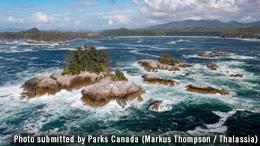
A stretch of ocean off BC’s central coast, where salmon, herring, whales, sea otters and some of the province’s largest kelp beds share waters with fishing boats and coastal communities, is moving toward federal protection.
Six First Nations, Ottawa and the province signed an agreement Friday to establish a new National Marine Conservation Area Reserve in the Great Bear Sea, beside the globally known Great Bear Rainforest.
“This is kind of the water offshoot of part of that,” BC Water, Land and Resource Stewardship Minister Randene Neill told Canada’s National Observer. “It protects some of our most biologically diverse and sensitive areas.”
Parks Canada officials say the reserve, once implemented, could protect up to 6,700 square kilometres (an area larger than Prince Edward Island) of coastal waters in one of the richest marine environments in the world.
Ottawa has committed major funding for the project. Budget 2024 proposed $167.5 million in federal funding for the reserve, including $42.9 million for infrastructure and assets, along with $10.7 million a year in ongoing funding.
The boundary is still being refined and could shift before final designation with some high-use areas near communities potentially left out and managed under existing rules. In a technical briefing for invited media Friday, the officials said the area generally stretches from south of Calvert Island through Central Coast inlets toward Bella Coola, with a northern boundary currently just south of Gil Island.
The Central Coast is not yet part of Parks Canada’s marine conservation network. Parks Canada notes the region’s rich marine life, coastal cultures and local economies depend on healthy waters increasingly pressured by habitat change, resource use and climate change.
The reserve will be called Mia-yaltwa Ha’lidzogm hoon, a name drawn from the languages of the partner Nations that means “Realm of the Salmon, Home of the Salmon.”
At the same time as the federal and provincial announcement, the Wuikinuxv, Nuxalk, Kitasoo Xai’xais, Heiltsuk, Gitxaała and Gitga’at Nations declared an Indigenous Protected and Conserved Area (IPCA) over the same waters.
Kitasoo Xai’xais Chief Chris McKnight called the designation “a long-awaited milestone,” adding the area will be recognized as both an Indigenous protected area and a National Marine Conservation Area Reserve.
“This marine protected area is not only a sanctuary for marine life but also a bold step forward in our shared responsibility as stewards of the ocean,” said McKnight in a statement. “I think this will be one of the strongest marine protected areas on the planet.”
The signing moves the project into a planning phase that will determine how the protected area is managed.
“There’s still a lot that needs to happen,” Neill said.
A management board made up of representatives from the six First Nations, Canada and BC will be created to guide the reserve’s next phase, including the development of a management plan and zoning rules that determine where conservation, fishing, tourism and other activities can take place, Neill added.
Paula Garo, executive director of protected areas establishment at Parks Canada, emphasized during a technical briefing that National Marine Conservation Areas are not blanket “no-use” zones, but are designed to protect marine ecosystems while allowing ecologically sustainable activities such as commercial fishing, tourism, recreation and Indigenous traditional uses.
Garo said the Central coast reserve would become the sixth protected area in Parks Canada’s National Marine Conservation Area network and would support local economies through tourism, stewardship and marine-based industries.
Fisheries rules are likely to be closely watched as that planning begins. After Parks Canada formally designates the reserve under federal law, the process is expected to take several years. DFO’s intention is that all fisheries except bottom trawling would continue under existing rules, said Kylene Ennis, director of fisheries policy and planning at DFO, said during a technical briefing for invited media.
Neill said trawling in the area has been limited in recent years.
Any future changes, Ennis said, would need “compelling evidence-based reasons” and consultation.
Ennis told Canada’s National Observer that the management board would develop zoning recommendations, including any recommendations affecting fisheries. Those would go to the federal fisheries minister, who retains regulatory authority over fisheries.
First Nations leaders say the agreement builds on generations of stewardship over the Central Coast marine environment and years of work to protect ecosystems that sustain their cultures, communities and economies.
“For many years, we have watched our oolichan disappear and our salmon stocks diminish,” Wuikinuxv Chief Marlou Shaw said in a statement. “It is our responsibility to care for this land, as it cares for us.”
Marilyn Slett, chief councillor of the Heiltsuk Tribal Council and president of the Coastal First Nations-Great Bear Initiative said the agreement reflects “decades of Indigenous leadership, collaboration, and persistence” to protect marine ecosystems that sustain coastal cultures, communities and economies.
The federal officials say the new reserve will help Canada move toward its goal of conserving 30 per cent of marine and coastal waters by 2030.
The agreement follows a feasibility study that ran from 2021 and 2024 and brought together the Wuikinuxv, Nuxalk, Kitasoo Xai’xais and Heiltsuk Nations, along with coastal communities, fishers, businesses and tourism operators.
Once formally designated, the reserve will require a management plan within five years under federal law. That plan will set out zoning rules and outline how the area will be protected, studied and used and cover conservation, cultural heritage, tourism and sustainable economic activities. An advisory committee is also expected to include local residents and representatives from the fishing and tourism sectors.
“Part of this protection is we want a really healthy ecosystem but we want people to come and visit,” Neill said. “We want people to be able to continue working in this area.”
Neill said the money would support monitoring, infrastructure, Guardian programs, visitor services, management planning and community capacity building. Success will be measured over years through monitoring of salmon, biodiversity, kelp and eelgrass beds and other signs of ecosystem health.
“This is exciting not just for the people who live in that area and not just for BC but also for Canada and quite frankly, the world,” Neill said. “This is a really special place, and everyone’s going to benefit from us looking at long-term sustainability and protection.”
Leave a comment